


Branded Dome Structure: Own the Spotlight at Roadshows

A branded dome structure can turn an ordinary roadshow stop into a recognisable corporate destination. Its distinctive form attracts attention before visitors reach the entrance. Meanwhile, tailored graphics help carry one campaign identity across different locations. For exhibitions, launches and touring activations, an event dome can support presentations, hospitality, demonstrations and meaningful conversations under one memorable roof.

Optix Inflatable Structures offers standard Domes from 6m to 24m for corporate applications. Businesses can therefore match the venue to audience numbers, available space and campaign objectives. With considered dome projection, controlled lighting and a practical custom event space, a travelling activation can maintain a consistent identity while still adapting to each venue. Explore Optix Inflatable Domes.
“Your logo, your brand, your message.” — Optix Structures
What Is a Branded Dome Structure for a Corporate Roadshow?
A branded dome is temporary architecture designed to carry a campaign from place to place. Optix lists inflatable Domes for roadshows, exhibitions, conferences, registration areas and hospitality spaces. Branding then gives that structure a clear visual identity. This makes it more than a simple dome shade structure placed around event activity.
Some planners may describe the concept as a branded event dome shade structure or temporary branded pavilion. Optix uses inflatable technologies rather than a conventional rigid framework. Depending on the project, branding, flooring, glazed doors and lighting can work together to create a polished environment that supports corporate presentations, meetings and visitor engagement.
From Temporary Shelter to Branded Roadshow Venue
A successful corporate roadshow needs more than somewhere dry to stand. The structure should introduce the campaign before the first conversation begins. Exterior graphics establish ownership while a planned entrance directs visitors towards registration, demonstrations or meetings. Inside, lighting and spatial organisation can continue the same identity, turning temporary architecture into a deliberate brand environment.
Branded Inflatable Dome vs Conventional Event Space
An inflatable Optix Dome shouldn’t be confused with a geodesic dome. Traditional geodesic dome design normally uses a triangulated rigid framework. Optix instead publishes Air Flow, Sealed Frame and Air Beam technologies. These methods use inflatable structural elements with different inflation, power and wind-performance characteristics. See Optix Technology Options.
Terms such as steel frame, high-quality steel frame and aluminium alloy commonly appear when businesses research rigid domes and marquees. They aren’t published construction specifications for the Optix inflatable Dome range. Procurement teams should therefore compare actual structural systems rather than copying generic competitor terminology into specifications or tenders.
Why Branded Dome Structures Work So Well Across Roadshow Stops
Roadshows constantly change location while the brand needs to remain familiar. A recognisable inflatable Dome can become the architectural thread connecting every stop. One venue might be a corporate campus while another sits within an exhibition. Yet the dominant graphics, campaign colours and visual character can remain recognisable throughout the programme.
Consistency also improves communication. Instead of rebuilding the creative concept at every location, teams can establish a repeatable hierarchy. The exterior creates recognition. The entrance explains what visitors should do. Interior zones support the next interaction. This approach can make temporary event buildings feel like deliberate campaign assets rather than temporary spaces filled with signage.
Create Brand Consistency Across Changing Locations
Consistency doesn’t require every roadshow stop to look identical. Keep the primary identity, dominant colours and principal message recognisable. Then adapt secondary content for regional audiences, partners or changing campaign phases. Optix temporary applied graphics and removable printed covers provide different ways to manage branding when creative requirements evolve between events.
Make Your Corporate Activation Visible Before Visitors Arrive
Distance changes how people read an event environment. Visitors walking through a busy exhibition rarely study long messages from across the hall. Large shapes, clear contrast and concise wording communicate faster. Detailed brand advertising information should appear later in the journey where visitors have time to engage with displays, presentations and knowledgeable staff.
Build a Repeatable Experience Without Making Every Stop Identical
A roadshow programme needs a stable backbone with room to adapt. The main Dome, core graphics and brand language can stay familiar while presentations, meeting areas or demonstration positions respond to each site. This balance helps the campaign feel consistent without forcing every venue into a floor plan that doesn’t suit its available space.
Choose the Right Optix Dome Size for Your Roadshow
Size should follow purpose rather than prestige. Optix currently lists 6m, 8m, 10m, 14m, 20m and 24m standard Domes. Published floor areas range from 20m² to 370m² while stated standing capacities range from 40 to 521. These figures provide useful starting points for corporate event planning.
However, capacity isn’t the same as usable campaign space. Product displays, furniture, screens, stages, staff positions and circulation all consume floor area. A Dome may accommodate a headline number of people while feeling crowded after production equipment enters. Start with the planned experience. Then choose the structure that can support it comfortably.
Optix Dome | Standing Capacity | Seated Capacity | Published Floor Space | Published Setup / De-Rig |
6m | 40 | 20 | 20m² | ≤ 0.5 hours |
8m | 54 | 29 | 36m² | ≤ 0.5 hours |
10m | 83 | 45 | 56m² | ≤ 1 hour |
14m | 171 | 92 | 120m² | ≤ 1 hour |
20m | 343 | 185 | 245m² | ≤ 1.5 hours |
24m | 521 | 281 | 370m² | ≤ 1.5 hours |
The figures above come from the current Optix Inflatable Domes range. Final capacity and layout decisions should still reflect equipment, circulation, production requirements and the individual event brief.
6m and 8m Domes for Focused Corporate Activations
Compact Domes can work well when the campaign values focused interaction over mass attendance. Optix publishes 20m² for its 6m Dome and 36m² for the 8m version. These structures can support appropriate smaller-scale corporate applications when registration, displays, staff positions and visitor circulation fit comfortably within the planned layout.
10m and 14m Domes for Larger Brand Experiences
More floor area creates greater flexibility. Optix publishes 56m² for its 10m Dome and 120m² for the 14m model. This additional space can accommodate more ambitious presentation or hospitality concepts. However, every added table, screen or demonstration point changes circulation. Leaving breathing room often creates a better experience than filling every available metre.
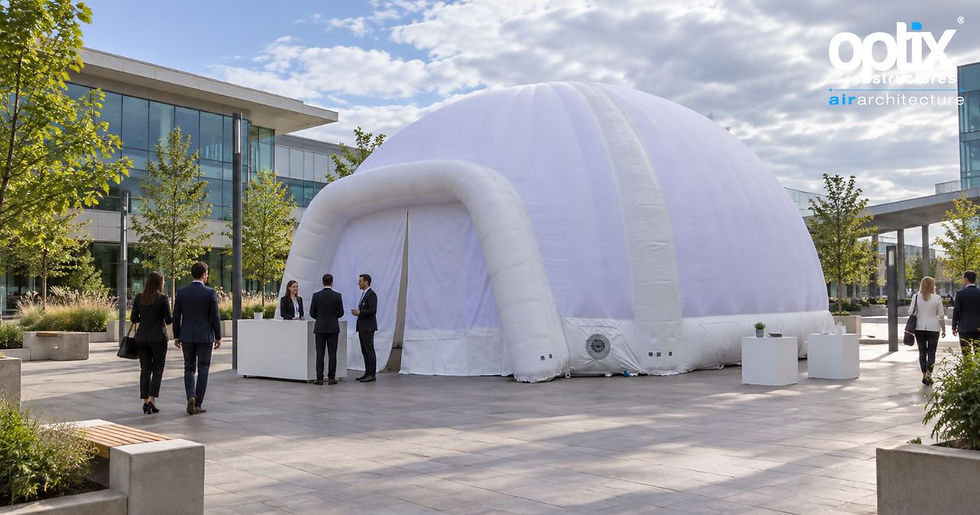
20m and 24m Domes for High-Capacity Roadshow Venues
Larger corporate programmes can move into substantial temporary venue territory. Optix publishes 245m² for the 20m Dome and 370m² for the 24m structure. The search phrase 20-meter-diameter dome uses US spelling, although UK editorial copy would normally describe the Optix product as a 20-metre Dome. Its published standing capacity is 343.

Match Capacity, Footprint and Visitor Flow Before Choosing
Headline capacity should begin the planning conversation rather than end it. Presentation seating creates aisles. Demonstrations attract stationary groups. Registration creates queues. Hospitality needs comfortable circulation. Consequently, the best event dome isn’t automatically the largest available. It is the model whose usable floor area supports the commercial experience without creating unnecessary congestion.
Turn Your Dome Exterior Into a Powerful Roadshow Brand Asset
Your exterior has only a few seconds to establish ownership. Optix offers temporary applied graphics, removable printed covers, direct printing, colour lighting, spotlight branding and projection branding. These routes support different campaign lifecycles. A short rental campaign may need flexibility while a purchased roadshow structure can justify more permanent creative treatment. Explore Optix Inflatable Branding.
Strong branding also requires restraint. Covering every visible surface with messages can weaken rather than strengthen recognition. Treat the Dome as large-format architecture. Establish one clear campaign identity first. Then add supporting information where visitors can absorb it comfortably. A disciplined visual hierarchy often feels more corporate, confident and premium than a structure carrying competing messages.
Use Temporary Applied Branding for Changing Campaign Messages
Optix describes temporary application as similar to vinyl graphic application. Artwork is printed onto adhesive media before being applied to the inflated structure. This approach can support changing campaign messages, partners or location information. It gives organisations flexibility when visual requirements evolve during a roadshow without permanently committing the base structure to one message.
Create Large-Format Identity With Printed Dome Covers
Optix removable printed covers are suitable for rental or purchased Dome structures. The fitted exterior cover can carry large-format campaign artwork while remaining removable and reusable. That makes the method particularly relevant to touring corporate activations where the same branded appearance needs to return across several events without relying on separate perimeter banners.

Consider Direct Printing for Suitable Purchased Structures
Direct printing incorporates graphics into suitable interior or exterior inflatable surfaces. It can suit purchased structures where branding will remain stable through repeated use. Optix also offers custom-size Domes as purchase-only projects. These tailor-made sizes should be treated as project-specific solutions rather than evidence that every possible dimension will automatically suit every location.
Extend Brand Identity Through Colour-Selective Lighting
Optix uses remote-controlled LED lighting to support corporate colours and event themes. Lighting can extend brand recognition after printed graphics become less prominent in dark halls or evening conditions. However, test the effect carefully. Strong coloured light can alter products, photography, presentation screens and skin tones. Brand consistency should never come at the expense of visual clarity.

Design the Interior Around the Roadshow Visitor Journey
External impact means little when visitors become confused after entering. Start by considering their first few seconds. Where should they go? What should they notice? Registration, demonstrations, presentations and sales conversations each create different movement patterns. A successful branded dome structure guides those behaviours naturally instead of forcing every activity into the same crowded zone.
Optix lists professional hard flooring with different finish options alongside free-standing glazed doors for its Domes. The requested phrase glass doors entrance is less precise than Optix’s published terminology, so “free-standing glazed doors” remains the more trustworthy product description. These finishing elements can contribute to a more composed corporate environment when included in the project.
Start With a Clear Arrival and Entrance Experience
The entrance sets expectations immediately. Visitors should understand where to register, whom to approach and why the experience deserves their time. Position the strongest visual cue around that first decision. Then reduce competing information. Clear arrival planning feels polished because it removes friction. Confusion can make even impressive architecture feel poorly organised.
Separate Registration, Demonstration and Conversation Zones
Different activities create different behaviours. Registration produces queues while demonstrations gather stationary groups. Business conversations need enough separation for people to talk comfortably. Placing everything around one narrow entrance can quickly create congestion. Instead, plan movement as a sequence from arrival to engagement and finally towards discussion, enquiry or another desired commercial action.
Use Flooring and Glazed Doors to Refine the Corporate Finish
Flooring affects much more than appearance. It influences furniture stability, movement and the overall feel of the environment. Optix offers hard flooring with carpet or alternative finishes while free-standing glazed doors can strengthen the sense of arrival. Combined thoughtfully, these options can make temporary architecture feel more considered without pretending it is a permanent building.
Plan Movement Before Adding More Content
Unused space isn’t wasted space. It gives visitors room to move, pause and understand their surroundings. Before adding another screen or display table, consider sightlines and natural walking routes. People tend to follow the easiest path available. Good event design works with that behaviour. Poor design fights it with obstacles, queues and excessive visual clutter.

Create Immersive Product Launches and Brand Experiences Inside the Dome
A memorable product launch event needs a clear story. Architecture can create anticipation, yet visitors still need to understand what is new and why it matters. Use the Dome to frame one central proposition. Demonstrations, knowledgeable staff and supporting content should then deliver the commercial substance behind the structure’s initial visual impact.
Searches for product launches activities often concentrate on spectacle. Corporate audiences usually need more. Give visitors something useful to experience. They might watch a demonstration, attend a briefing or discuss a practical application. When interaction connects directly with the campaign objective, the Dome becomes a business environment rather than an oversized branded photo opportunity.
Stage Product Reveals Around One Strong Focal Point
Visitors should know where to look. Position the main product or presentation around a strong sightline while allowing supporting graphics to explain rather than compete. Lighting can create hierarchy without flooding every surface with attention. When every display shouts at once, the hero product loses authority. Corporate launch design often benefits from confident visual restraint.
Turn Demonstrations Into Guided Brand Stories
Structure the experience like a concise narrative. Introduce the commercial challenge first. Demonstrate the relevant solution next. Then create space for questions and business discussion. This sequence can make technical products easier to understand. It also gives staff a common framework, helping the physical environment and the sales conversation reinforce the same proposition.
Use Projection and Lighting Without Creating Visual Clutter
Optix offers projection branding and states that its inflatable surfaces can be mapped for creative content. Well-planned dome projection can introduce logos, movement or scheduled campaign moments without permanently changing the structure. Projector selection, content development, throw distance and ambient light remain separate production considerations. Explore Optix branding methods.
Create Corporate Hospitality That Still Serves the Campaign
Hospitality should have a commercial reason to exist. It might support scheduled meetings, partner discussions or networking after a presentation. Keep the campaign identity present without surrounding guests with constant sales messages. Comfortable dwell time can create valuable conversations because decision-makers often explore detail after the formal demonstration rather than during the busiest part of the activation.
Case Study: Bath Spa University’s Reusable Branded Dome
Optix supplied Bath Spa University with a 20m inflatable Dome featuring a full printed cover, flooring and carpet. The structure served as a registration focal point across open days during a two-year period. Its longest documented installation exceeded one month. The project provides useful evidence of repeat branded use rather than a hypothetical roadshow scenario.
Plan Setup, De-Rig and Logistics Across Multiple Roadshow Locations
Roadshow architecture must move effectively as well as look impressive. Optix publishes setup and de-rig figures of 30 minutes or less for its 6m and 8m Domes. The 20m and 24m structures are listed at 1.5 hours or less. This makes quick assembly and transport a relevant planning consideration when programmes move between locations.
However, Dome installation time isn’t total event build time. Flooring, doors, graphics, lighting, AV, displays, furniture and testing can require additional work. Treat every stop as a coordinated production sequence. One delayed contractor can affect several others. Detailed scheduling protects rehearsal time, visual quality and the opening deadline when successive roadshow dates sit close together.
Build a Repeatable Roadshow Installation Plan
Create the deployment sequence before the tour starts. Confirm the site first. Then organise structure installation before flooring, graphics and production fit-out where appropriate. Repeatable processes reduce avoidable surprises as the campaign travels. They also help teams identify which parts of the build remain constant and which elements require location-specific decisions.
Survey Access Before the Roadshow Reaches Each Venue
A structure may fit perfectly once installed yet still face difficult access. Check loading areas, gates, corridors, available height and surface conditions early. UK HSE guidance also advises organisers to consider ground conditions, topography, wind exposure and safe pedestrian or vehicle access. Read HSE venue and site design guidance.
Separate Dome Setup Time From Total Event Build Time
Published structure timings shouldn’t become unrealistic promises for the entire activation. A Dome can reach its structural setup point while carpeting, graphics, screens, furniture and testing still require considerable work. Build the production schedule around every element. This protects technical checks and rehearsal time rather than encouraging teams to rush the final stages before visitors arrive.
Coordinate De-Rig With the Next Campaign Stop
De-rig deserves the same planning as installation. Production equipment and furnishings need an orderly removal sequence while reusable branding should be handled appropriately for future deployment. Transport must also align with the next location. Roadshows rarely suffer because one task is impossible. Problems usually emerge when several small delays meet in the same narrow timetable.
Rent or Buy a Branded Dome Structure for Your Roadshow?
Ownership should follow campaign requirements rather than enthusiasm alone. Optix currently lists its standard 6m to 24m Domes as available to rent or buy while custom-size Domes are purchase only. A temporary rental venue can make sense for shorter programmes while ownership may suit organisations expecting repeated use across a longer event calendar.
Optix also provides direct and managed purchase routes. Direct purchase leaves future installations with the client using supplied instructions. Managed purchase allows Optix to handle physical, logistical and storage processes. The managed option is specifically described as suitable for brands running roadshow installation series. See Optix purchase options.
Route | Best-Fit Corporate Scenario | Main Planning Question |
Rental | Short campaigns or individual events | How long will the structure be required? |
Direct Purchase | Repeat use with suitable internal resources | Can your organisation manage deployment and storage? |
Managed Purchase | Recurring roadshows needing operational support | Which ownership tasks should Optix manage? |
Custom Purchase | Project-specific Dome requirements | Does the brief require something beyond the standard range? |
When Branded Dome Hire Fits a Corporate Campaign
Hire can work well for a short campaign, an individual launch or a programme that doesn’t justify ownership. Businesses can still apply substantial branding. Optix specifically offers temporary applied graphics and removable printed covers for suitable rental Dome projects. This allows the campaign to establish a distinctive identity without turning short-term use into long-term asset ownership.
When Buying Supports Repeat Roadshow Use
Frequent deployment changes the commercial equation. Ownership can provide a consistent branded asset across exhibitions and corporate activations. However, the purchase cost tells only part of the story. Transport, storage, installation, cleaning, maintenance and future artwork changes also matter. Compare the complete programme rather than treating one rental quotation and one purchase quotation as equivalent options.
How Managed Purchase Can Support Recurring Roadshows
Managed purchase bridges ownership and operational outsourcing. Optix states that it can handle storage, logistics, installation, removal, cleaning and maintenance for managed structures. This model may suit marketing teams that want a repeatable branded asset without building permanent specialist logistics capability internally. Explore Optix Managed Purchase.
When a Custom Dome Becomes Relevant
Standard models cover a broad range of event requirements. Some corporate briefs still need different dimensions or a more integrated branded design. Optix lists custom Dome sizes as purchase only. In those situations, tailor-made sizes should emerge from the actual footprint, audience, operational requirements and intended use rather than from a desire to make the structure larger unnecessarily.
Prepare Each Roadshow Site for Safe, Reliable Dome Operation
Outdoor use requires careful planning. Optix’s Dome table publishes 33/55 mph wind information while its technology comparison provides different ballasted figures for Air Flow, Sealed Frame and Air Beam structures. Calling any Dome a weather resistant structure therefore needs context. Final operation should follow the selected product specification, installation method and site-specific guidance.
Materials also require accuracy. Search results for temporary structures frequently mention PVC fabric or a PVC fabric cover. However, the current public Optix Dome page doesn’t publish those phrases as Dome material specifications. They shouldn’t be presented as confirmed Optix facts. Corporate procurement teams should obtain project-specific technical documentation whenever fabric composition or another material specification affects purchasing requirements.
Check Surface, Dimensions and Access at Every Roadshow Stop
Ground conditions can alter installation planning significantly. Grass, paving and exhibition flooring each present different considerations. HSE advises UK event organisers to assess ground load-bearing capacity, anchoring conditions, topography, extreme weather and safe access. Those checks help ensure the site plan reflects the real venue rather than assumptions carried over from a previous stop. Read HSE guidance.
Understand Wind Figures in the Correct Structural Context
A single wind number shouldn’t be separated from its structural context. Optix’s technology table lists ballasted figures of up to 34 mph for Air Flow, 37 mph for Sealed Frame and 55 mph for Air Beam. Its Dome product table separately shows 33/55 mph. Project-specific documentation should therefore govern operating decisions.
Plan Power Around the Structure and Event Production
Inflatable technologies have different electrical requirements. Optix states that Air Flow needs continuous running power while Sealed Frame requires no running power after inflation. Air Beam combines pumps and fans. Lighting, projectors, screens, sound systems and other production equipment create additional demand. Plan the complete electrical load instead of treating structural power as the entire event requirement.
Include Accessibility, Emergency Planning and Visitor Operations
Accessibility should enter the floor plan early. In the United States, ADA standards state that applicable accessibility requirements extend to temporary as well as permanent facilities, including exhibit areas. UK organisers must consider relevant venue, equality and event requirements. Clear circulation and appropriate emergency planning should complement the branded design rather than be added afterwards. U.S. ADA Standards for Accessible Design.
Treat Severe Weather as an Event Plan Issue
A structural wind specification doesn’t replace an event weather plan. Outdoor corporate programmes should establish responsibilities for monitoring conditions, suspending activity and moving visitors where required. U.S. National Weather Service guidance recommends having defined thunderstorm procedures for organised outdoor activities. Read National Weather Service lightning guidance.
How to Build a Branded Dome Roadshow That Audiences Remember
Memorability comes from coherence rather than spectacle alone. Your branded dome structure should connect the first exterior impression with the experience inside. Graphics create recognition. Lighting shapes atmosphere. Demonstrations communicate value. Staff provide human context. When each part supports one campaign idea, the Dome strengthens the brand rather than simply becoming an impressive object beside it.
Commercial measurement matters equally. Large visitor numbers can look successful without producing meaningful outcomes. Track qualified conversations, demonstration participation, dwell time, meeting requests and relevant follow-up opportunities. The objective is not merely to photograph a busy event dome. It is to create a temporary corporate environment that helps marketing and sales teams achieve measurable objectives.
Keep One Recognisable Brand Language Across the Tour
Give each roadshow stop the same visual grammar. Maintain the primary colours, dominant graphics and central campaign proposition while adapting secondary information for each market. Consistent architecture helps returning visitors recognise the campaign. Flexible messaging keeps it relevant. Together, these elements create continuity without forcing every venue into an identical creative treatment.
Give Visitors a Reason to Enter Rather Than Only Look
A distinctive Dome can stop people in their tracks. It can’t automatically make them care. Pair the architecture with a useful reason to enter. Offer a demonstration, briefing, product reveal or valuable conversation. The visitor should quickly understand what awaits inside. Attention becomes commercially useful only when curiosity turns into meaningful participation.
Measure Engagement Beyond Raw Visitor Numbers
Attendance tells only part of the story. A smaller group of relevant decision-makers can generate greater commercial value than a much larger casual audience. Connect measurement to campaign objectives. Demonstrations completed, meetings requested, qualified contacts and agreed follow-ups can provide stronger evidence of intent than footfall alone, especially for complex B2B products and services.
Plan the Next Branded Dome Roadshow With Optix Structures
Begin with dates, locations, audience expectations, planned activity, site dimensions and branding requirements. Then compare Dome size, hire or purchase, structural technology and compatible finishing options. The Optix Inflatable Domes range, Inflatable Branding options and Technology Options provide useful first-party information for that discussion.
A strong corporate roadshow should feel as though your organisation has arrived with its own destination rather than simply hired temporary floor space. Done carefully, branded architecture becomes a repeatable visual signature. It can support brand activations, launches, registration, demonstrations, presentations and hospitality while keeping the campaign recognisable across multiple locations.
Frequently Asked Questions
How much does a branded, geodesic or inflatable dome structure cost in the UK?
The cost depends on size, branding, rental duration, accessories and whether you hire or buy. Optix doesn’t publish one universal Dome price, so businesses should request a project-specific quotation based on the actual roadshow brief.
What are branded dome structures used for?
Corporate branded Domes can support roadshows, exhibitions, conferences, registration, product launches, hospitality and other temporary event applications. Optix specifically lists several of these uses across its Dome range.
Are branded or geodesic dome structures waterproof or weatherproof for UK conditions?
Weather suitability depends on the specific structure, installation and site conditions. Optix publishes wind information for its Dome range, but outdoor operation should always follow project-specific specifications and event weather procedures rather than a blanket “weatherproof” claim.
What is the difference between inflatable, geodesic and air-supported branded dome structures?
Geodesic domes normally use rigid geometric frameworks. Optix inflatable structures instead use technologies such as Air Flow, Sealed Frame and Air Beam, each with different inflation, power and structural characteristics.
Can you fully customise or print branding on dome structures?
Yes, subject to the selected structure and project. Optix offers temporary applied graphics, removable printed covers, direct printing, colour lighting, spotlight branding and projection. Several methods can also be combined where compatible.


Comments