


Brand Roadshow Pod: Command Attention at Every Tour Stop

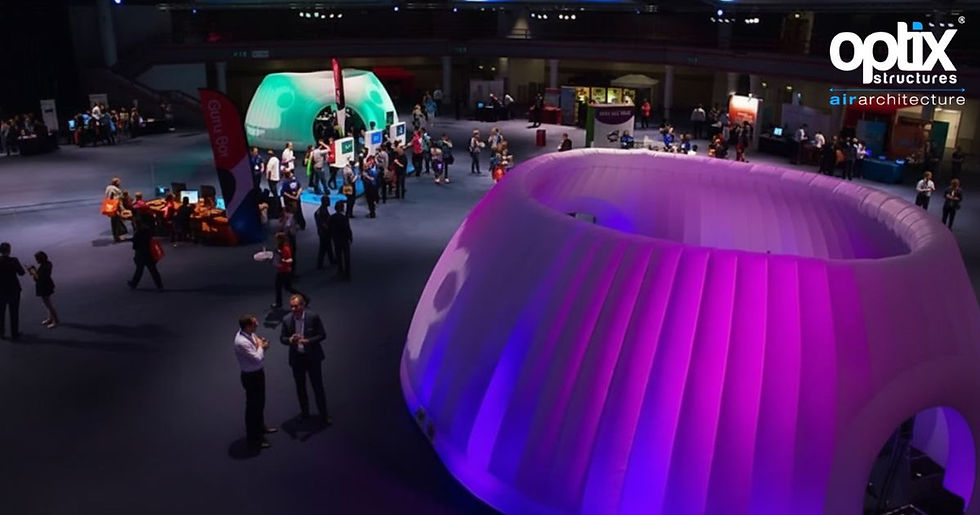
A brand roadshow pod gives corporate teams a consistent environment as campaigns move between venues. Designed around meetings, product demonstrations, registration and campaign engagement, it can help your organisation create a familiar presence without permanent construction. Unlike a mobile roadshow truck, an inflatable pod becomes temporary architecture inside a suitable event venue.

That flexibility suits multi-location programmes where the surroundings change but the campaign identity must remain coherent. Careful branding, visitor flow and spatial planning can support brand awareness, face-to-face conversations and clearer engagement with potential customers. For corporate teams running repeated events, the pod becomes a practical part of the campaign system rather than a decorative backdrop.
“Your logo, your brand, your message.” — Optix Inflatable Structures.
What Is a Brand Roadshow Pod?
A brand roadshow pod is a temporary corporate environment used across roadshows, exhibitions and related business events. Instead of designing an entirely unrelated stand at every destination, you can create a recognisable setting around movable spaces, corporate graphics, lighting, furniture and carefully planned visitor activity. The exact configuration depends on the selected structure and brief.
The concept differs from a mobile stage, promotional trailer or mobile car showroom. Those formats generally make a vehicle or platform central to the experience. An Optix inflatable pod creates defined architectural space inside a suitable venue instead. Inflatable Office Pods are specifically listed for roadshows and exhibition spaces.
A Branded Roadshow Pod Is More Than a Portable Stand
Think of the pod as a recognisable room that moves with the campaign. London may look nothing like Chicago, yet your graphics, interaction model and brand’s message can remain familiar. This makes the format particularly relevant to corporate brand tours where consistency matters without forcing every venue into an identical floor plan.
Why Brand Roadshow Pods Work Across Multiple Tour Stops
Consistency becomes harder when a campaign enters diverse markets. Ceiling heights change, floor plans move and installation windows vary. A roadshow pod gives planners a repeated visual and functional starting point. However, it doesn’t remove logistics or geographical barriers. Every venue still requires its own access, safety and production review.
This balance between continuity and adaptation can strengthen corporate experiential marketing. The pod provides the recurring element while entrance orientation, external signage, furniture and supporting production adapt to local conditions. Instead of rebuilding the entire experience at every stop, teams can retain what audiences need to recognise and modify only what the venue requires.
Keep One Identity Without Making Every Stop Identical
Strong roadshows repeat the important elements rather than copying every detail. Keep the principal structure, campaign message and visual identity familiar. Then adapt supporting components to the space. This creates recognisable mobile exhibitions while allowing a Manchester conference hall and a New York convention venue to function according to their own practical constraints.
Which Optix Pod Is Right for Your Corporate Roadshow?
Product choice should begin with what visitors need to do. Optix Inflatable Office Pods are published for meetings, roadshows, exhibitions, registration, interviews and temporary boardroom-style activity. Four standard sizes are currently listed for rent or purchase. Custom sizes are available as purchase-only options.

Panoramic Pods serve a different type of indoor brief. Their roofless design can preserve views of chandeliers, architectural details and suspended branding. Optix lists roadshows, conferences, breakout spaces, exhibitions, registration and hospitality among their applications. Options include hard flooring, glazed doors, colour-selective lighting and supported branding treatments. Explore Optix Panoramic Pods
Optix Office Pod | Approx. US dimensions | Standing | Seated | Floor space | Structure set-up/de-rig |
3 × 3 × 2.5m | 9.8 × 9.8 × 8.2ft | 6 | 4 | 4.5m² | Up to 15 mins |
3 × 4 × 2.5m | 9.8 × 13.1 × 8.2ft | 10 | 6 | 6m² | Up to 15 mins |
4 × 5 × 2.5m | 13.1 × 16.4 × 8.2ft | 18 | 10 | 12m² | Up to 15 mins |
5 × 6 × 2.5m | 16.4 × 19.7 × 8.2ft | 20 | 16 | 20m² | Up to 20 mins |
Optix publishes these capacities and structure times for its Office Pod range. Its own event-office guidance also provides the approximate imperial conversions shown above for US planners. Furniture, technical equipment, doors, branding and testing can extend the complete installation beyond the inflatable structure time.
Panoramic Pod or Inflatable Office Pod?
Choose according to the interaction rather than appearance alone. Office Pods suit more focused meetings and discussions. Panoramic Pods can define larger open indoor zones while preserving overhead architectural visibility. Your venue, expected occupancy, branding, furniture and visitor journey should determine the final choice. Optix currently publishes no populated Panoramic capacity table, so those figures shouldn’t be invented.
Match Your Roadshow Pod to the Business Objective
Every corporate roadshow needs a clear commercial purpose. A pod used for executive meetings needs a different layout from one supporting third-party sampling stations or live product demonstrations. Start by asking what visitors must actually do. They may need to watch, register, discuss, compare, enquire or arrange a follow-up conversation.

For a technical B2B campaign, carefully positioned interactive displays can support explanation before a deeper discussion. If your third-party fit-out includes digital screens, position them around sensible viewing distances and circulation. These items aren’t presented as standard Office Pod accessories. They should form part of the wider event-production brief rather than an assumed pod specification.
Product Demonstrations Need More Than Technology
Effective interactive campaigns help visitors understand why a product matters. A screen may explain internal components or processes that people cannot see directly. However, the technology needs a purpose. Allow space for questions and technical conversations afterwards. The demonstration should lead interested potential customers towards a meaningful next step rather than ending with a visual spectacle.
A pod isn’t a comprehensive marketing solution on its own. Campaign creative, staffing, media, sales follow-up and local promotion still shape performance. Temporary architecture gives these activities somewhere coherent to happen. Used thoughtfully, it can make the environment support the wider promotional campaign instead of operating as an attractive but disconnected object.
Turn Your Roadshow Pod Into a Recognisable Brand Asset
Good roadshow branding works quickly. Optix documents colour lighting, spotlight branding, temporary applied graphics, removable printed covers for suitable Dome applications, projection and direct printing across its inflatable range. Not every method suits every structure or procurement route. The chosen treatment should therefore match the product, campaign duration and ownership model. See Optix Inflatable Branding options
Temporary graphics use artwork printed onto adhesive media and applied while the structure is inflated. Direct print can integrate branding into suitable purchased structures. Optix also gives the example of purchasing a printed inflatable for a roadshow campaign and combining it with interior corporate colour lighting.
Keep Roadshow Branding Clear at Real Viewing Distances
Busy event environments reward clarity. A visitor approaching from across an exhibition hall may only have seconds to understand who you are and why the space matters. Lead with one recognisable identity and a concise campaign idea. Secondary details can appear closer to the engagement point. Filling every surface with copy usually weakens rather than strengthens the hierarchy.
Repeated use should also influence creative decisions. Short programmes may favour adaptable graphics while purchased structures used for recurring brand tours can support longer-term treatments. Thoughtful consistency can contribute to broader market penetration activity across different territories, although the structure itself can’t guarantee awareness, leads or commercial growth.
Plan Pod Size, Capacity and Visitor Flow at Every Stop
Published capacities provide a useful benchmark, but they don’t replace a scaled plan. The largest standard Office Pod measures 5 × 6 × 2.5 metres and lists twenty standing or sixteen seated occupants. Tables, displays, equipment, staff and accessible movement all consume usable space. Practical capacity should follow the actual event layout.

Visitor flow deserves equal attention. People should be able to notice the area, understand its purpose, enter comfortably and continue their journey without crossing active demonstrations or queues. Entrance position can change the whole experience. An apparently generous footprint can still feel cramped when furniture, waiting visitors and presentation equipment compete for the same circulation route.
Plan UK and US Accessibility Early
Accessibility belongs in early spatial planning. In the United States, the 2010 ADA Standards state that covered requirements apply to temporary and permanent buildings and facilities, including certain exhibit areas. Review the relevant venue and project obligations rather than assuming a temporary installation sits outside accessibility requirements. Review the U.S. ADA Standards for Accessible Design
For England, Scotland and Wales, current Equality Act guidance explains that relevant service providers must anticipate disabled people’s needs and consider reasonable adjustments. Practical obligations depend on the circumstances. Corporate planners should involve the venue and suitably qualified professionals when reviewing access routes, entrances, furniture, signage and emergency movement. Read the UK Equality Act service-provider guidance
Build a Repeatable Setup Plan for Every Roadshow Location
Touring campaigns benefit from a repeatable production sequence. Office Pods support relatively rapid setup and teardown at structure level, with published times of up to fifteen or twenty minutes depending on size. However, complete installation also involves any flooring, doors, lighting, branding, electrical work, furniture, audiovisual equipment, cleaning and final testing.
Use each venue plan to confirm access, positioning and supplier sequencing before arrival. Then coordinate the supporting fit-out around the pod. Testing the environment as a visitor would can reveal awkward sightlines, queues or blocked approaches. These details matter before the target audience enters because small spatial problems tend to become larger when an event gets busy.
Case Study: Roofless Corporate Meeting Structures in Vienna
A verified Optix project in Vienna demonstrates why venue conditions matter. Optix supplied ten roofless meeting structures in an approximately 2,500m² hall: five 14-metre Panoramics and five 12-metre Pyramics. The roofless approach responded to sprinkler requirements while third-party suppliers handled carpeting, furniture and AV.

The case is useful for organisations planning nationwide tours because it shows that the inflatable structure is only one part of a corporate installation. Columns, sprinklers, rigging, flooring, ceiling height and supplier sequencing can affect the finished plan. A consistent pod can travel with the campaign while its supporting production adapts to each venue.
Hire, Buy or Use Managed Purchase for a Roadshow Pod?
Hire can suit temporary programmes that don’t justify ownership. Optix currently offers its four standard Office Pod sizes for rent or purchase. Custom sizes are listed as purchase only. Corporate buyers should compare event frequency, branding, storage, internal resources and logistics rather than judging the decision on structure cost alone.
Purchase can make more sense when the pod becomes a recurring brand asset. Yet ownership also creates storage, maintenance, transport, cleaning and installation responsibilities. Optix’s Managed Purchase service addresses that operational burden and is specifically described as ideally suited to brands running a roadshow series of installations. Explore Optix Managed Purchase
Commercial route | When it may fit | Main consideration |
Hire | Temporary or occasional corporate programmes | Confirm availability, branding, logistics and project scope |
Purchase | Recurring events with internal operational resources | Plan storage, transport, maintenance and installation |
Managed Purchase | Repeated roadshows requiring ownership with support | Optix manages storage, logistics, installation, removal, cleaning and maintenance |
Custom purchase | Unusual footprints or established campaign identities | Allow for design, approval, manufacture and logistics |
Optix states that Managed Purchase covers storage, logistics, installation, removal, cleaning and maintenance. Structures are kept in its temperature-controlled storage facilities with cleaning and maintenance plans. The service therefore offers a different procurement model from simple hire or unsupported ownership.
Think Beyond the Initial Structure Cost
The lowest purchase price doesn’t necessarily create the lowest campaign cost. Transport, labour, storage, creative updates, furniture, technical production and venue requirements all affect the operating model. Compare the whole programme. A suitable procurement route should make repeated deployment predictable while supporting the level of brand control and internal involvement your organisation actually needs.
Measure Whether Your Brand Roadshow Pod Is Working
Busy photographs don’t prove commercial success. Define useful measures before the roadshow starts. A sales programme might track qualified conversations and meeting requests. A product launch could monitor completed demonstrations and technical discussions. Recruitment campaigns may value suitable applications. The measurement framework should reflect the business objective rather than generic footfall.
For B2B campaigns, quality often matters more than volume. Ten relevant conversations with decision-makers may carry greater commercial value than hundreds of casual visits. Compare results between locations carefully because audience mix, programme timing, local promotion, competing activity and venue traffic can all influence performance independently of the pod.
Connect Measurement to the Next Commercial Action
Lead capture should preserve useful context. Record what interested the visitor and what follow-up makes sense. For UK direct marketing, the ICO advises organisations to plan data protection from the start, use an appropriate lawful basis, collect information fairly and explain how it will be used. Read the ICO direct marketing guidance
Measurement can also improve later stops. If digital screens gain attention but conversations stall, refine the transition to staff engagement. If third-party sampling stations create congestion, adjust their position. A touring programme creates repeated opportunities to learn, allowing each location to inform the next without changing the campaign’s recognisable core.
How to Plan a Brand Roadshow Pod That Commands Attention
Start with the business objective and target audience. Decide what visitors need to see, understand and do. Then review capacity, venue dimensions, meetings, demonstrations, branding, accessibility, staffing and logistics. Choosing the structure after defining these requirements reduces the risk of building an attractive environment that doesn’t support the commercial programme.
Avoid selecting a pod simply because competitors use a mobile roadshow truck or roadshow vehicle. A mobile stage or mobile car showroom solves a different spatial problem. Optix Office and Panoramic Pods are temporary inflatable architectural structures. They should be evaluated around the activity, venue and visitor experience they genuinely need to support.
Build a Roadshow System Rather Than Separate Stands
A strong roadshow feels like one programme moving through several destinations. Keep the core visual identity and operational logic consistent. Adapt sensibly to local constraints. This approach can reinforce brand awareness as a campaign reaches diverse markets, while preventing venue-to-venue variation from making the experience feel disconnected.
For B2B experiential marketing, the physical environment can connect public engagement with deeper commercial conversations. A wider activation may use third-party interactive displays or product demonstrations, while a pod provides room for focused discussions with potential customers. The architecture creates the setting. Staff expertise, useful content and disciplined follow-up create the commercial substance.
Before planning a campaign, review the current Optix ranges and branding routes. Explore the Optix Inflatable Office Pod range, review Panoramic Pod options and compare Inflatable Branding methods. Organisations planning recurring programmes can also consider Managed Purchase for storage, logistics and structure management.
A well-planned brand roadshow pod doesn’t replace campaign strategy. It gives that strategy a recognisable physical setting. Across exhibitions, corporate venues, mobile exhibitions and multi-stop brand tours, the goal remains practical: create a professional environment that people can recognise, approach and use confidently at every tour stop.
Frequently Asked Questions
What is a brand roadshow?
A brand roadshow is a campaign that takes a consistent branded experience to several locations. Corporate teams may use it to meet different business audiences, demonstrate products, build relationships or support a wider marketing programme.
What is the purpose of a roadshow?
A roadshow brings a company closer to selected audiences across multiple locations. Depending on the objective, it can support demonstrations, meetings, market education, relationship-building and brand visibility.
How do you plan a roadshow marketing campaign?
Start with the business objective, audience and route. Then confirm venues, structure requirements, branding, staffing, accessibility, production, logistics, measurement and follow-up so each location supports the same campaign strategy.
What are the benefits of a roadshow truck or mobile roadshow?
A mobile roadshow can create a travelling branded environment across several locations. Vehicle-based solutions differ from Optix inflatable pods, so businesses should compare venue access, campaign activity, capacity and logistical requirements before choosing a format.
What is the difference between a roadshow and a pop-up?
A roadshow usually follows a planned series of locations as one connected campaign. A pop-up normally operates temporarily at one location, although a wider campaign may use several pop-ups across different destinations.


Comments