


Outdoor Event Structures: Create Unforgettable Brand Impact

Corporate outdoor events compete for attention before the first presentation begins. The right outdoor event structures can transform an open site into a recognisable business environment. They provide shelter, organise visitor movement, support technical production, and make your company visible across busy event grounds.

Unlike basic temporary shelters, modern inflatable venues can combine clear interiors, modular layouts, lighting, graphics, flooring, and practical weather protection. However, success still depends on informed event planning considerations, including capacity, access, power, ground conditions, branding, safety, and the structure’s commercial purpose.
What Are Outdoor Event Structures?
Outdoor event structures are temporary spaces installed where permanent buildings aren’t available or suitable. Corporate teams use them for product launches, exhibitions, conferences, roadshows, registration areas, hospitality suites, temporary showrooms, open days, presentations, and stakeholder events. Their real value comes from function, visibility, and operational flexibility.
The wider events market includes marquees, tipis, clearspan tents, and capri tents. You may also encounter igloos, portable pop-ups, rigid dome systems, and premium architectural installations. Optix takes a different route through inflatable structures designed for temporary corporate environments.
How Inflatable Structures Differ from Traditional Formats
A traditional geodesic dome relies on a rigid framework. Inflatable architecture uses air-supported structural systems instead. This approach can produce clear internal areas without conventional support poles. It also creates shapes that feel more distinctive than standard tents or decorative luxury constructions.
Good structures organise people as carefully as they protect them. Guests should quickly understand where to enter, register, watch, meet, and leave. Therefore, corporate spaces must accommodate signage, furniture, audiovisual equipment, hospitality service, accessible routes, technical access, and emergency planning.
Why Are Inflatable Structures Ideal for Corporate Outdoor Events?
Inflatable structures give brands an architectural presence without permanent construction. Their curved or geometric shapes can become landmarks within crowded outdoor venues. Inside, open floor areas provide flexibility for stages, displays, seating, catering, demonstrations, and meetings without conventional poles interrupting important sightlines.
They can also support immersive experiences through lighting, printed surfaces, projection, sound, and controlled visitor journeys. Thoughtful atmosphere creation allows the same space to host a daytime presentation before changing into an evening hospitality venue with a different mood and visual identity.
Flexible Layouts for Complex Corporate Programmes
Modular arrangements allow separate spaces to support different business activities. A dome might host a keynote while a cube houses demonstrations. Smaller pods can provide meeting areas nearby. Strong event design connects these zones so the experience feels intentional rather than fragmented.
Installation speed can help tight production schedules. However, inflation time isn’t the same as complete installation time. Flooring, doors, graphics, lighting, heating, cooling, furniture, and audiovisual systems extend the programme. Product-specific set-up information should always guide the final schedule.
Which Optix Outdoor Event Structure Should You Choose?
The best choice depends on audience size, activity, site conditions, brand style, access requirements, technical production, and desired openness. A covered stage solves a different problem from an enclosed conference venue. Likewise, a compact activation needs less space than a national product launch.
Optix’s verified outdoor-capable range includes Inflatable Domes, Inflatable Cubes, Air Roofs, Luna Pods, and custom inflatables. Each structure supports different corporate objectives and site footprints.
Inflatable Domes for Conferences and Hospitality
Optix offers standard domes from 6 to 24 metres in diameter. Published standing capacities range from 40 to 521 people, depending on size. Domes can support conferences, roadshows, exhibitions, registration, hospitality, awards events, temporary retail, and seasonal events.
Inflatable Cubes for Exhibitions and Launches
Inflatable cubes create a clean, geometric environment suited to exhibitions, product displays, presentations, hospitality, roadshows, and temporary retail. Optix lists sizes from 6 metres to 25 by 15 metres. The largest standard option has a published standing capacity of 427 people.
Air Roofs for Stages and Open Presentations
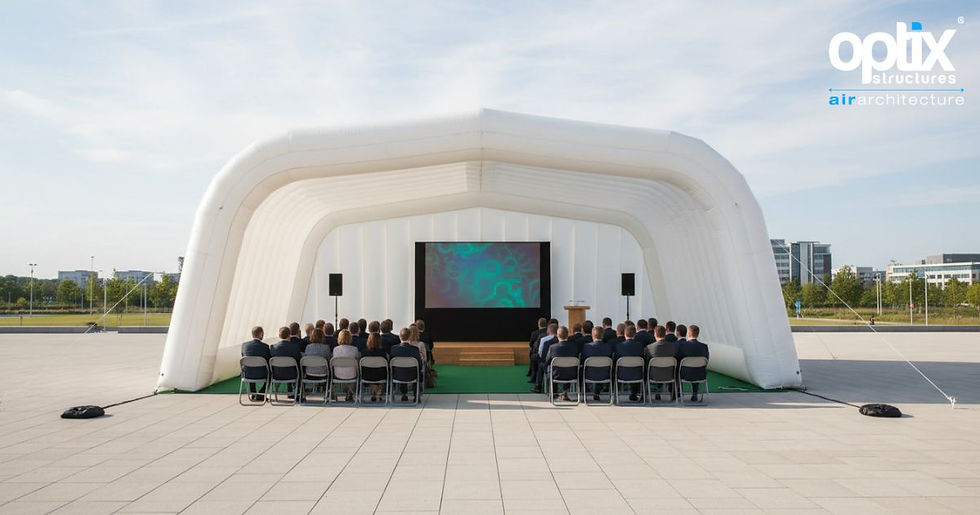
Air Roofs suit events that require overhead coverage while maintaining an open connection with the audience. Optix’s system starts with a modular 12-by-6-metre shelter. Published uses include conferences, breakout stages, exhibitions, open days, hospitality, and product presentations.
Luna Pods for Smaller Brand Touchpoints
The detailed Luna specification lists a 5.5-by-4.5-metre structure accommodating 12 standing or eight seated guests. It requires a 16-amp supply and carries a published 33 mph wind rating. Its compact footprint suits consultations, registration, meetings, and smaller activations.

Bespoke Structures for Original Campaign Ideas
A bespoke inflatable structure can support unusual shapes, dimensions, artwork, doors, windows, screens, lighting, data points, hidden audio, or storage. Optix uses three-dimensional visualisation to help clients review the structure before production begins.
Optix structure | Published size range | Suitable corporate use | Main planning advantage |
Inflatable Dome | 6m to 24m diameter | Conferences, launches, hospitality, roadshows | Broad capacity range and strong visual presence |
Inflatable Cube | 6m to 25m × 15m | Exhibitions, product displays, branded venues | Geometric form and modular planning |
Air Roof | 6m × 12m and 12m × 12m listed | Stages, demonstrations, open presentations | Shelter with an open audience connection |
Luna Pod | 5.5m × 4.5m listed | Meetings, registration, compact activations | Small footprint and rapid set-up |
Bespoke Inflatable | Project-specific | Original campaign environments | Customised form, branding, and features |
Optix domes may also support winter-style igloos, while Air Roofs can offer alternatives to conventional festival structures. A Luna could provide a compact sponsor space during a festival themed event. Every outdoor application still requires project-specific confirmation.
Case Study: A Bespoke Inflatable Cube in Iraq
A worldwide media agency commissioned Optix to produce a bespoke 12-by-12-metre cube for a lifestyle brand’s experiential campaign in Iraq. The made-to-measure structure demonstrates how custom architecture can translate a campaign brief into a distinctive physical environment. (Read the case study)

How Can Outdoor Event Structures Strengthen Brand Impact?
Powerful branding starts before visitors read a logo. Shape, lighting, entrances, exterior graphics, and surrounding space all influence perception. Distinctive outdoor event structures can become recognisable landmarks that help attendees locate your organisation while creating useful backdrops for photography, video, media coverage, and social content.
The structure should also support the commercial journey. Guests might register, watch a presentation, explore a demonstration, attend a consultation, and finish in hospitality. When each transition feels connected, the venue becomes part of the brand story rather than an unrelated collection of hired components.
Connect Architecture with Measurable Objectives
Visual drama should serve a defined outcome. The event might aim to increase registrations, attract demonstrations, generate qualified conversations, support stakeholder hospitality, or produce campaign content. Agreeing these measures early helps the structure support marketing, communications, and sales rather than becoming an expensive visual ornament.
Case Study: Reusable Dome Branding
Optix supplied Bath Spa University with a 20-metre dome featuring a printed cover, flooring, carpet, and lighting. The venue supported registration at several open days across two years. Its longest installation lasted more than one month. (Read the case study)
What Branding Options Are Available for Outdoor Structures?
Optix’s inflatable branding options include colour lighting, projected logos, temporary applied graphics, removable printed covers, projection mapping, and direct printing. Several approaches can work together. The right combination depends on structure type, campaign duration, ownership, viewing distance, and environmental light.

Branding should remain easy to understand. Covering every surface with logos can weaken the message. One memorable campaign statement, a controlled colour palette, and a strong focal point often communicate more effectively than visual clutter. Your structure should look coherent from both visitor routes and camera positions.
Branding method | Suitable corporate application | Key planning consideration |
Colour lighting | Corporate colours and zone identification | Test visibility during daylight and darkness |
Spotlight branding | Reusable logo or short message | Confirm projection angle and viewing distance |
Temporary graphics | Short campaigns and changing messages | Allow time for artwork approval and installation |
Printed covers | Large reusable branding areas | Confirm compatibility with the chosen structure |
Projection mapping | Launches and changing digital content | Plan brightness, power, weather cover, and equipment |
Direct printing | Purchased or bespoke structures | Choose artwork with long-term relevance |
Design Branding for Real Viewing Conditions
Curved structures require careful artwork placement. Seams, doors, lighting, queues, and furniture may obscure important messages. Review drawings or three-dimensional visuals before production. Branding should remain legible from primary approaches and appear correctly in photographs, video, and press coverage.
How Do You Choose the Right Size and Event Layout?
Attendance provides a starting point rather than a finished layout. Two events with 200 guests may need very different floor areas. A standing reception requires circulation and catering space. A keynote needs seating, aisles, a stage, screens, audio control, camera positions, and technical access.
These event planning considerations should follow the main commercial objective. A product launch needs controlled sightlines. An exhibition needs accessible displays and meeting areas. Client hospitality requires comfort, discreet service routes, and quieter conversations. Capacity tables must therefore be interpreted alongside the complete programme.
Layout factor | Question to resolve |
Attendance | How many people will arrive during the busiest period? |
Format | Will guests stand, sit, dine, watch, or move between activities? |
Stage and AV | Where will screens, cameras, speakers, and controls be positioned? |
Product display | How much viewing and demonstration space is required? |
Hospitality | Where will catering, bars, staff, and waste routes operate? |
Accessibility | Can every visitor enter, circulate, view content, and leave safely? |
Operations | Where will staff, equipment, packaging, and technical supplies remain? |
Plan the Visitor Journey Before Adding Furniture
Map how people approach, queue, enter, move, pause, and leave. Registration, displays, stages, meeting points, and hospitality should follow a clear sequence. Avoid crossing public routes with service access. Allow extra space around popular demonstrations where crowds may form unexpectedly.

Connected structures can support more complex programmes. A dome could house the keynote while a cube supports demonstrations. Lunas might provide meeting areas nearby. An Air Roof could cover live content. This approach creates varied zones while maintaining one coherent corporate environment.
What Site and Infrastructure Details Must Be Planned?
Early site preparation reduces expensive changes. Confirm the usable footprint, surface, slopes, drainage, overhead restrictions, underground services, nearby buildings, and prevailing wind direction. These details influence structure position, access, anchoring or ballast planning, guest circulation, emergency routes, and technical equipment.
Reliable event logistics also require accurate delivery information. A spacious field may have a narrow gate. Urban sites may restrict working hours. Historic properties may protect lawns or paving. Share site photographs, measured drawings, access windows, loading restrictions, and known utilities before finalising the design.
Build Health and Safety into the Initial Plan
Treat health and safety as a design input rather than a final check. The UK Health and Safety Executive advises organisers to consider ground capacity, anchoring points, prevailing winds, flooding, vehicle movement, pedestrian routes, and emergency access when positioning temporary structures. (HSE venue guidance)
For UK projects, organisers should also review guidance for temporary demountable structures. US projects should follow applicable federal, state, venue, fire, building, and local requirements. No single checklist covers every jurisdiction or event type.
Plan Power and Supporting Infrastructure
Air Flow structures require continuous fan power. Sealed Frame structures don’t require ongoing power after inflation. Air Beam systems use pumps and fans. Lighting, audiovisual equipment, heating, cooling, catering, and charging stations add further loads. Every supply should match the approved equipment schedule.
How Do Weather, Wind and Inflatable Technology Affect Selection?
Outdoor structures shouldn’t be described as universally weatherproof. A better description is weather-resistant within confirmed operating limits. Published wind ratings depend on the model, construction system, installation, ballast or anchoring arrangement, surface, and site. Changing weather conditions still require active monitoring and clear decision-making.
Optix lists dome and cube configurations with 33 or 55 mph figures. Air Roof tables show the same alternatives, while the Luna carries a published 33 mph figure. These values don’t replace professional installation, site assessment, inspections, or an event-specific weather plan.
Optix technology | Inflation equipment | Running power | Published ballasted wind figure |
Air Flow | Fans | From 6 amps | Up to 34 mph |
Sealed Frame | Pump | Not required after inflation | Up to 37 mph |
Air Beam | Pumps and fans | From 4 amps | Up to 55 mph |
Understand the Three Construction Systems
Air Flow uses integral fans and continuous pressure. Sealed Frame systems use inflated tubes and don’t need running power afterwards. Air Beam combines Air Flow and sealed structural elements to increase wind performance and offer temporary support if power fails.
Weather Protection Involves More Than the Roof
Effective weather protection also considers rainwater, muddy entrances, ground softness, solar gain, ventilation, heating, cooling, electrical routes, wet queues, and lightning. US teams should review current OSHA lightning guidance alongside venue and local emergency procedures.
Corporate buyers should also discuss durability requirements. A one-day launch creates different demands from a touring roadshow or extended installation. Transport frequency, storage, cleaning, branding changes, maintenance, operating conditions, and staff capability all affect the most suitable technology and ownership model.
Should Your Business Rent, Buy or Commission a Bespoke Structure?
Rental often suits one-off events and short campaigns. Optix asks about the location, surface, permitted area, capacity, and intended use before recommending a structure. Rental projects may also include printed covers, temporary branding, flooring, lighting, doors, heating, and cooling.
Purchase can suit repeat campaigns that need consistent availability and permanent branding. Direct buyers manage installation using supplied instructions. Managed purchase adds storage, logistics, installation, removal, cleaning, and maintenance for companies that lack the internal resources to manage the asset.
Procurement route | Best suited to | Main advantage | Main responsibility |
Rental | One-off projects and short campaigns | Lower long-term commitment | Confirm availability and production lead times |
Direct purchase | Frequent use with internal resources | Ownership and repeat availability | Manage storage, transport, installation, and care |
Managed purchase | Roadshows and touring programmes | Ownership with operational support | Provide accurate schedules and locations |
Bespoke commission | Original corporate requirements | Custom shape, features, and branding | Allow time for design, approval, manufacture, and testing |
Consider the Complete Operating Life
Repeated seasonal events may justify ownership, while a single launch may favour rental. A national roadshow can benefit from managed purchase. Bespoke production suits campaigns requiring unusual architecture or integrated features. The lowest initial quotation doesn’t always provide the strongest long-term value.
The right structure does more than cover an outdoor area. It can make your business visible, organise the visitor journey, support presentations, strengthen campaign consistency, and produce lasting media value. Explore the Optix Inflatable Structures range or submit a detailed brief through the Optix contact page.
Frequently Asked Questions
What Are the Different Types of Outdoor Event Structures?
Common choices include marquees, tents, inflatable domes, cubes, stage roofs, compact Luna Pods, and bespoke structures. Other suppliers may offer tipis, clearspan systems, rigid domes, or capri-style tents. The best option depends on purpose, capacity, site, branding, and technical needs.
How Much Do Outdoor Event Structures Cost to Hire in the UK?
Hire costs vary according to structure type, dimensions, duration, location, transport, installation, flooring, doors, lighting, climate systems, and branding. Optix doesn’t publish one fixed rental price because each corporate project requires a tailored specification and quotation.
What Is the Best Structure for an Outdoor Event in the UK?
The strongest option depends on the programme. Domes suit larger conferences, hospitality, and launches. Cubes suit exhibitions and product displays. Air Roofs work for stages and open presentations. Lunas support compact meetings, registration points, and smaller activations.
Are Outdoor Event Structures Weatherproof?
No structure should be treated as weatherproof in every condition. Suitable inflatable structures provide protection within confirmed operating limits when correctly installed. Product-specific wind ratings, anchoring or ballast, inspections, forecasts, ground conditions, and emergency procedures must guide outdoor operation.
How Long Does It Take to Set Up Outdoor Event Structures?
Published set-up and de-rig times vary by product. A Luna is listed at up to 15 minutes, standard domes and cubes range from approximately 30 to 90 minutes, and larger Air Roof options may require up to 2.5 hours before additional production elements.


Comments