


Event Structure Delivery Europe: Seamless Event Success
- Alex Ford

- 2 days ago
- 9 min read
Planning event structure delivery Europe demands more than booking transport and choosing a venue. Corporate teams need a clear schedule for loading, cross-border movement, site access, installation, power, branding, supplier coordination, and de-rig. Well-planned temporary event structures can support conferences, exhibitions, launches, meetings, and European roadshows without forcing every location into the same rigid format.

Inflatable solutions also create flexible display spaces that can adapt to different corporate environments while keeping brand presentation consistent. For businesses running multi-city campaigns, early logistics planning reduces disruption and protects setup time. The result is a smoother journey from warehouse to venue, with event structure hire and installation working around the wider production programme.
Optix describes its approach as “transforming air into architecture.”
What Does Event Structure Delivery Europe Involve?
European delivery starts with a project brief, not a freight booking. Corporate event structure hire needs confirmed dates, venue dimensions, loading windows, final positions, power, branding, and supplier access. With pop-up event structures, you should also separate inflation time from the complete installation programme, which may include flooring, doors, lighting, AV, furniture, and testing.
The wider touring market includes exhibition trailers, roadshow trucks, and mobile showrooms, yet these are not Optix products. Optix focuses on inflatable architecture for meetings, exhibitions, conferences, roadshows, and branded corporate environments. That distinction keeps the logistics plan tied to the structure actually being specified rather than blending unrelated mobile formats.
Why Inflatable Structures Simplify European Event Delivery
Packed efficiency can reshape a multi-city event budget and timetable. modular event structures arrive in a compact form before becoming sizeable working spaces at the venue. They can support plenaries, breakout rooms, registrations, launches, and exhibitions. Compared with many rigid portable exhibition units, inflatable systems also avoid conventional internal support poles within the usable space.
Brand consistency matters when the same campaign moves between cities. In experiential marketing, the environment should feel recognisable before delegates reach the presentation screen. Optix offers printed covers, temporary graphics, and lighting on relevant structures, helping a corporate brand activation create memorable high-impact event spaces while maintaining a coherent visual identity across locations.
Which Optix Event Structures Can Be Delivered for European Projects?
Different programmes call for different footprints. Inflatable Domes span 6m to 24m in the published range, while Inflatable Cubes provide geometric interiors and modular options. Air Roofs create open presentation areas. Together, these structures can form flexible display spaces and practical product demonstration solutions for corporate projects.

Other touring formats include promotional vehicles, shipping container conversions, and mobile promotion units, but they should remain comparison terms rather than Optix product claims. Within Optix’s verified range, Lunas, Office Pods, Inflatable Walls, Panoramic Pods, Pyramic structures, and bespoke inflatables provide further choices for meetings, zoning, activations, and larger temporary environments.
Optix structure | Verified published format | Corporate planning fit | Commercial route |
Inflatable Domes | 6m to 24m diameter | Conferences, exhibitions, roadshows, hospitality and registration | Rent / Buy |
Inflatable Cubes | 6m cube to 25m × 15m | Conferences, exhibitions, launches and roadshows | Rent / Buy |
Air Roofs | 6m × 12m and 12m × 12m | Presentations, stages and open event zones | Rent / Buy |
Luna | 5.5m × 4.5m × 2.8m high | Compact meetings, displays and registration | Rent / Buy |
Office Pods | 3m × 3m to 5m × 6m | Meetings, interviews and breakout rooms | Rent / Buy |
Inflatable Walls | 1m to 10m detailed sizes, 2.5m high | Zoning, exhibition spaces and temporary rooms | Rent / Buy |
Published specifications vary by individual product. For example, Optix lists Domes from 6m to 24m and Office Pods from 3m × 3m to 5m × 6m, while custom sizes can follow different purchase conditions.
How to Choose the Right Event Structure for Your European Venue
The right structure begins with the business activity inside it. Audience size matters, yet seating style, circulation, production equipment, presentation sightlines, and hospitality needs matter too. self-drive promotional vehicles and converted shipping containers for events solve different touring problems. Inflatable structures make more sense when you need temporary architectural space around a defined corporate programme.

Venue geometry can overturn an attractive concept in minutes. Columns, low ceilings, chandeliers, sprinklers, doors, rigging, and fixed services can reshape the layout. Even container bars for events and festivals, which sit outside Optix’s range, show the same principle: the chosen format must fit the operational site rather than forcing the venue around the design.
The Optix Vienna project demonstrates this clearly. Its hall contained columns and required roofless structures because of venue health-and-safety and sprinkler considerations. Five 14m Panoramic structures and five 12m Pyramic structures divided approximately 2,500m² of usable floor area.
Planning Cross-Border Event Structure Delivery Across Europe
Cross-border planning adds ownership, customs, route, and timing questions to the production schedule. Companies comparing short and long-term hire should establish where each asset originates, who owns it, how long it will remain overseas, and whether it returns afterwards. For multi-stop European roadshows, plan the outward journey, each onward movement, storage gaps, and final return together.
UK teams may use an ATA Carnet for qualifying temporary exports that will return to the UK, while EU Temporary Admission can apply to eligible non-Union goods intended for re-export. US teams should check their own carnet arrangements before dispatch. These procedures depend on the goods and route, so customs advice should be confirmed for each project.
For UK projects, GOV.UK guidance on ATA Carnets explains how qualifying temporary exports can use a carnet. The European Commission outlines Temporary Admission, while US companies can review the International Trade Administration ATA Carnet guidance. GOV.UK specifically includes exhibition goods among examples of goods that may qualify.
An ATA Carnet isn’t automatically appropriate for every movement. GOV.UK states that covered goods must be intended to return to the UK, while EU rules place conditions on temporary admission. The European Commission also notes that some procedural differences remain among EU Member States.
Venue Access, Power and Installation Requirements to Plan Early
A structure can fit the floor plan yet fail at the loading door. Check loading-bay dimensions, vehicle access, lifts, corridors, ceiling clearance, working hours, surface conditions, and final positioning before dispatch. Then confirm electrical capacity. Optix uses different inflatable technologies, so the selected product specification should guide power planning, backup arrangements, and installation sequencing.

Optix describes Air Flow, Sealed Frame, and Air Beam technologies with different operating characteristics. Air Flow needs continuous fan power. Sealed Frame remains inflated without running power after inflation. Air Beam combines airflow with sealed structural beams. These differences affect inflation equipment, packed size, running power, sound level, and published ballasted wind performance. See Optix Technology Options.
Optix technology | Inflation equipment | Running power | Published ballasted wind figure |
Air Flow | Fans | From 6 amps | Up to 34 mph |
Sealed Frame | Pump | Not required after inflation | Up to 37 mph |
Air Beam | Pumps and fans | From 4 amps | Up to 55 mph |
These figures come from Optix’s technology comparison rather than one universal product specification. Individual structure data, ballast or anchoring requirements, site conditions, weather, and venue procedures still need separate project assessment.
From Load-In to De-Rig: Coordinating Event Structure Installation
Production sequencing often decides whether event day feels controlled or chaotic. Optix describes a typical process that starts with electrics and site preparation, followed by a ground sheet, structure positioning, lighting, fans, and inflation. The wider installation can still take longer because doors, flooring, branding, production equipment, and venue-specific requirements must join the same schedule.

Supplier choreography becomes critical once the structure is ready. Flooring and power may come first, followed by structure installation, AV, furniture, décor, testing, and rehearsals. This order appeared in the Vienna project. For US planners, “de-rig” may be called “teardown,” yet the principle remains identical: every contractor needs a defined handover window.
Optix’s Vienna account also explains that the team aimed to leave a full day for AV and furniture suppliers before rehearsals. That detail matters for corporate production managers because an inflatable may be physically installed before the wider event environment becomes operationally ready.
Vienna Case Study: Delivering 10 Event Structures in Europe
The Vienna project gives this topic genuine first-hand evidence. Optix supplied ten larger inflatable meeting spaces for classroom-style sessions, using five 14m Panoramic structures and five 12m Pyramic structures. The installation divided roughly 2,500m² of usable hall space and created meeting areas for more than 1,000 people within one large venue. Read the Vienna case study.
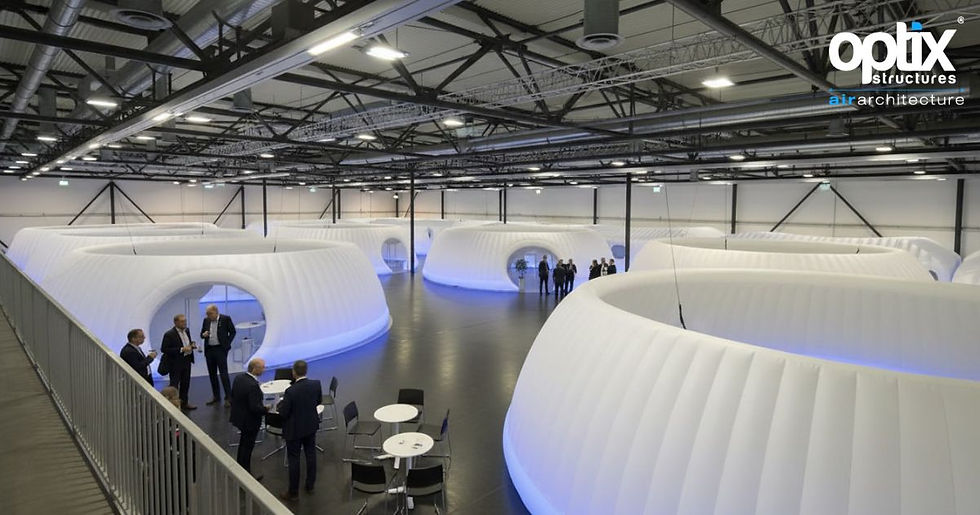
The logistics show why project-specific planning matters. Optix records a 17-hour warehouse-to-Vienna drive, two medium panel vans, three Optix crew members, and local stagehands. Setup took about 12 hours and de-rig about nine. Roofless structures also addressed sprinkler requirements, while doors, LED lighting, AV, furniture, and wireless headphones completed the event environment.
These timings shouldn’t be treated as universal promises. The Vienna installation involved ten structures, a particular venue, local labour, specific room layouts, and known production requirements. Optix’s own FAQ states that installation time varies with structure design, size, environment, and surface.
Hire, Buy or Managed Purchase for European Event Programmes
Commercial strategy should follow campaign frequency and internal resources. Hire can suit one-off events or changing requirements. Purchase gives repeat users greater control over a dedicated asset. Optix also offers a managed-purchase structure management service, covering storage, logistics, installation, removal, cleaning, and maintenance for clients who want ownership without managing every physical process themselves.
Managed purchase can be especially useful when branded mobile environments must appear repeatedly across corporate locations. Optix identifies roadshow series as a suitable use case. Purchased structures can use printed covers, direct printing, or temporary graphics where relevant, helping brands keep a consistent identity while adapting campaign messaging between individual events and destinations. Explore Managed Purchase.
Commercial model | Best suited to | Main operational consideration |
Hire | One-off or occasional corporate projects | Availability, destination, installation and agreed options |
Direct purchase | Regular deployment by an internal team | Training, storage, logistics, cleaning and maintenance |
Managed purchase | Recurring events and roadshows | Deployment schedule and agreed management scope |
Bespoke purchase | Project-specific designs or dimensions | Design, production, branding and lead time |
Optix’s homepage states that rental includes maintenance, dismantling, delivery, and professional installation. Its purchase page separates direct purchase from managed purchase, where Optix handles the physical, logistical, and storage processes associated with ownership.
Event Structure Delivery Europe Checklist for Corporate Teams
A useful European delivery brief turns assumptions into confirmed project data. Record the event city, venue, dates, programme, audience, seating plan, usable footprint, ceiling height, loading access, power, surface, branding, accessories, AV, supplier timetable, installation window, rehearsal period, event hours, de-rig deadline, and next destination before transport arrangements are finalised.
Then test the entire journey rather than one isolated installation. Confirm that every venue can receive the transport, every structure fits its allocated area, each site provides suitable power, and branding remains appropriate. Strong event marketing structures depend on logistics, architecture, production, and brand experience working as one corporate system instead of four disconnected workstreams.
Corporate planning question | Why it matters |
What activity will happen inside the structure? | Guides format, capacity and interior planning |
What are the usable venue dimensions? | Identifies conflicts with doors, ceilings, columns and services |
When can installation begin? | Protects AV, furniture, testing and rehearsal time |
What power does the structure require? | Optix technologies have different operating requirements |
How will branding work at each location? | Supports visual consistency across the campaign |
Who handles temporary export and customs procedures? | Clarifies responsibility before cross-border movement |
What happens immediately after the event? | Defines de-rig, storage, return or onward transport |
Is hire, purchase or managed purchase appropriate? | Links commercial strategy with event frequency and resources |
Corporate logistics become easier when each decision supports the next. The broader market may contain self-drive promotional vehicles, trailers, containers, and other travelling formats. Optix instead specialises in inflatable architectural solutions for corporate meetings, conferences, exhibitions, roadshows, launches, temporary zoning, and branded event environments.
A precise project brief therefore remains the strongest starting point for event structure delivery Europe. When venue data, logistics, technical requirements, branding, and event operations are known early, teams can evaluate the right structure and commercial route without relying on assumptions that may create problems later.
Frequently Asked Questions
Are delivery, assembly and dismantling included in the hire cost of a temporary event structure?
Optix states that its rental service includes delivery, professional installation, maintenance, and dismantling. The final quotation will still depend on the selected structure and specific project requirements.
Do temporary event structures need planning permission in the UK?
Not always. In England, permission depends on the land use, physical works, permitted-development rights, and project circumstances. Check the relevant local planning authority before installation because other permissions may also apply.
How do you transport or ship event equipment / structures across Europe?
Transport planning should match the structure, route, venue access, installation timetable, and customs procedure. Optix’s Vienna project, for example, moved ten meeting structures from the UK using two medium panel vans.
What documentation is needed for temporary event structures or equipment moving from the UK to Europe?
An ATA Carnet can cover certain qualifying temporary exports, including exhibition goods, when they will return to the UK. Other customs or Temporary Admission procedures may apply depending on the goods and route.
How much does it cost to hire temporary event structures, including delivery?
Optix does not publish one universal hire price for every project. Request a project-specific quotation because structure choice, destination, hire period, installation, branding, accessories, and other agreed requirements can affect the final scope.


Comments